



Welcome to Let’s Get Lost! I’m Rebecca, a recipe developer, food photographer, passionate people watcher, and chaser of new experiences. You might know me from my recipe websites, Of Batter and Dough and A Little and A Lot.
My husband and I are nomads without a home base but with many modes of transportation, namely an RV, a motorcycle, and a sailboat. I write recipes and stories for curious people who believe experiences are more important than things and who want more adventure.
—> Get this and every issue and recipe directly on rebeccablackwell.com.
Are you a fellow food writer or recipe developer? Here are three resources just for you!
I didn’t really have a choice in the matter
Earlier this week I listened to a podcast discussion with Kathryn Paige Harden about her new book.
The title of the book is what drew me to listen to the podcast. Original Sin: On the Genetics of Vice, the Problem of Blame, and the Future of Forgiveness
Tell me more, Kathryn.
This was the first I’d heard of Kathryn Paige Harden. I have not (yet) read Original Sin. But after listening to her speak, the book is in my Kindle library, taunting me to start reading instead of being a responsible adult and, you know, doing my job.
And now is when I say the thing that is practically guaranteed to annoy, possibly infuriate, some of you. (I speak from experience.) I think the idea of a self-made person is a fantasy and that almost everything in our lives can be attributed to luck.
I have a very complicated relationship with the word “choice”. Here is something that I wrote about recently that begins to sum it up.
Many of the choices I have been afforded are exceedingly generous in a world where choices are generally quite limited. We don’t choose where and when we are born, the people we are born to, and the circumstances we are born into.
We don’t choose our personality, or our brain chemistry, or the overall state of how everything grew together before we even were allowed to take our first breath. We are born with the genetic makeup of the many generations that came before us and we had no say in its particulars. We are the product of everyone else’s choices long before we have a chance to make one of our own.
There is no such thing as a self-made anyone.
I am happy to take credit for creating a life I love. But my ability to do so is a pure stroke of luck.
So, you can see why I was drawn to Katheryn’s book.
In a conversation with Kate McDermott last week, during which I was laying out an idea for yet another collaboration in which I want her to take part, she suddenly said, “Rebecca, were you always like this?”
Ummmmm… probably?
I am not a competitive person. In fact, if I suddenly find myself in a competitive situation, I freeze up and start looking for an exit strategy.
Part of it is that I’m terrible under pressure. I used to run (figuratively and literally-but in this case, I mean literally) and I was never tempted to enter any kind of race. I would be the first person kicked off of a competitive, high pressure cooking show because once the cameras started rolling I’d forget my name and how to boil water.
I love playing board games but don’t care at all about winning. And if the people I’m playing with care deeply about winning, it loses the appeal.
I’m not into competitive sports (surprise, surprise), but love watching any sport with people who are really into it. The fun is in watching the people who are really into it. I couldn’t care less about who wins or loses.
I don’t want to rank things or be ranked.
The best way to deplete me of all motivation is to pit my effort against someone else’s.
I am, however, very collaborative.
As a kid, I always had so many ideas for the next thing that my friends and I could do. Which is perhaps not the most honest way of stating it? More accurately, I had big ideas and needed people to make them happen.
But, the thing I’ve been thinking about is that my big ideas generally require the involvement of other people. There are a lot of big ideas. Not all of them require other people. So it feels significant that mine usually do.
Earlier this year we passed through Phoenix and had dinner with an old childhood friend we hadn’t seen in over a decade. At one point, as we were weaving our way through childhood memories, he said, “We never had to come up with ideas about what to do because you just told us.”
Have I always been like this? I suppose I have.
I started my first recipe site in 2013 and until I started writing this newsletter here on Substack, my work was a mostly solitary endeavor.
I like this too. It’s the other side of the coin. I’ve mentioned before that one of the first things I learned how to say was, “Leave alone. I do it myself.”
I rarely tire of being alone, and too many social engagements leave me drained and depleted.
But, over the past couple of years my collaborative nature has been pushing itself forward. Rather forcefully, I might add. And I’m having a marvelous time. In fact, if the number of collaborations in your life guaranteed wealth, I’d be a gazillionaire.
(It doesn’t, by the way, make you a gazillionaire.)
The very nature of collaboration requires generosity. It starts with the belief that there’s enough for everyone and that by working together, the end result will be better for all of us. It isn’t a zero-sum game. No ranking occurs. Win or loose, we’re in it together.
The CookStack Collective is one of these collaborations. We’ve just begun and it is already so much fun. Twelve food writers have come together to create a 12-month series of cooking classes. To participate you only need to be a paid subscriber to one of our publications. Not all of them. Not two of them. Just one.
The truly wonderful thing about this group is that we are all food writers and recipe developers working hard to make a living doing what we love to do. So, you might think we’d see one another as competitors.
Instead, we’ve chosen collaboration. It’s the kind of collaboration that only works if we all believe there’s enough for everyone. This is a big table, and if it gets too small we’ll just build a bigger one.
Mastermind For Food Writers is another example. Every month, a group of food writers gathers over Zoom and share ideas, insights, knowledge, and information. Openly and freely.
And look. I know this isn’t some sort of new revelation. Open collaboration happens in ways big and small in most of our lives every single day. Even the simple act of offering advice to a friend, sharing some hard-won experience with a co-worker, tag-teaming your to-do list with your spouse, or a neighborhood garage sale requires generous, open, non-competitive collaboration.
And also, it sometimes feels like the world is a harsh, polarized, competitive, zero-sum game that I don’t want to play. These generous opportunities to work with people instead of against them is like a balm. I am soaking it in.
So, yes, Kate. I suppose I have always been like this.
But I didn’t really have a choice in the matter, did I?
The best yellow cake of your life
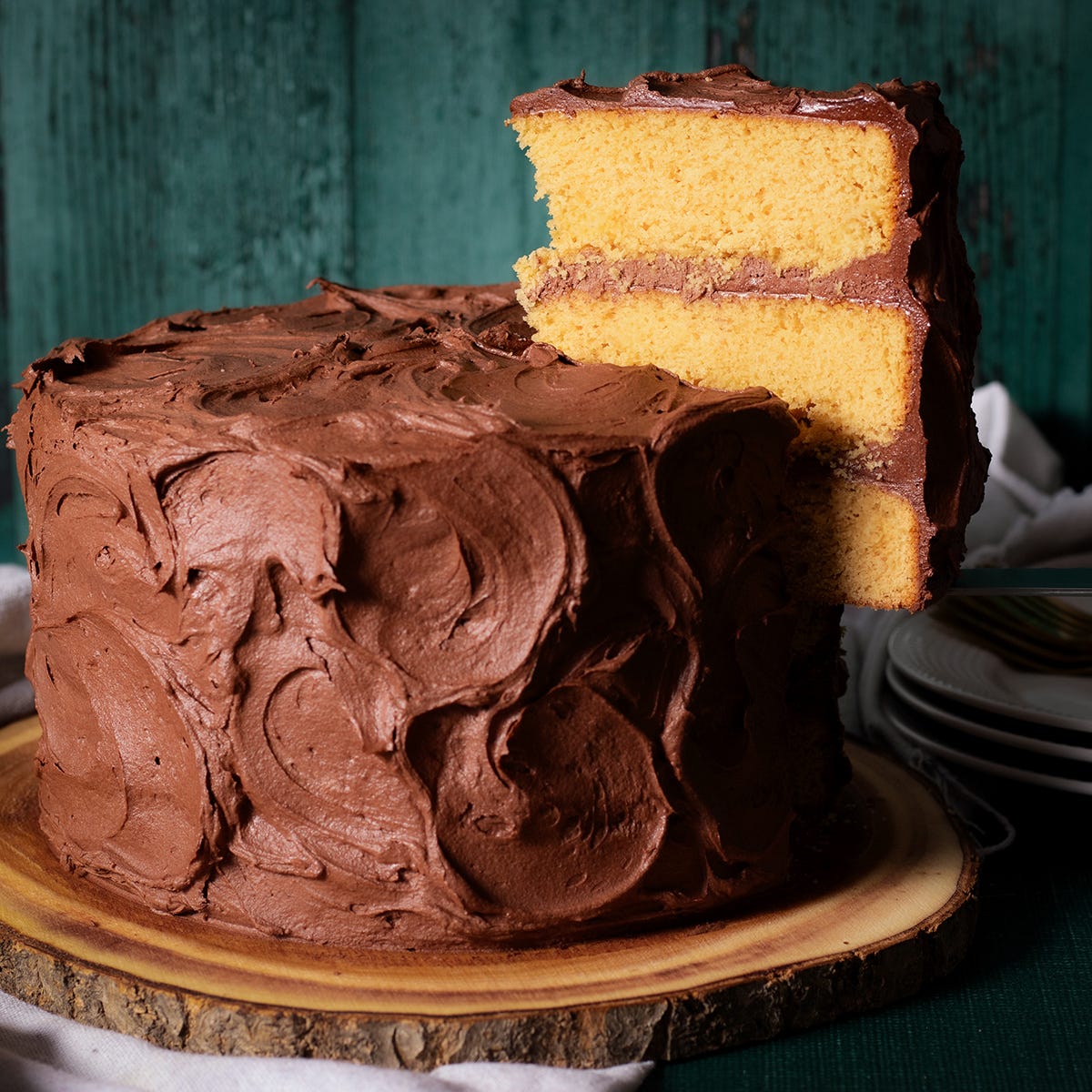
Speaking of collaborations, I’ve recently started thinking of cookbooks from a collaborative perspective. Because isn’t that exactly what they are? The author openly shares recipes, tips, ideas, and stories that we incorporate into our lives, making them part of our kitchens and part of our story.
Case in point: I just purchased Obsessed With The Best by Ella Quittner. It’s a masterpiece. Five stars. Ten out of ten. Highly recommend.
In the book, she talks about using white wine to improve your yellow cake. Of course I had to try it, and holy smokes, if it didn’t make a noticeable difference in the yellow cake I’ve been making for years!
Here’s what you do: Replace half of the buttermilk in this recipe with white wine. I know it sounds a little bit nuts, but it gives this cake an even softer, tighter crumb that just melts in your mouth.
If you’re not a wine drinker, know that the buttermilk-only version is very, very good. I’ve been making it for decades with no complaints. There is no need to buy a bottle of wine that you won’t drink.
But if you have a bottle of white in your fridge, try it. You’ll be amazed by the results.
Recipes that start with chimichurri
If I could keep one sauce in my refrigerator all the time, chimichurri would be very high on the list.
And when I say could, I can and I do.
Especially in the summer when I want easy recipes that require very little cooking.
Chimichurri sauce is one of the best ways I know to instantly brighten a dish with fresh flavor and color. Aside from being totally delicious, it’s healthy, versatile, and quick to prepare, and doesn’t require turning on your stovetop.
It also keeps well in the refrigerator for several days. So make a big batch and use it all week long.
Below, you’ll find my favorite chimichurri sauce recipe, plus a collection of recipes that put it to very good use.
Chimichurri Sauce!
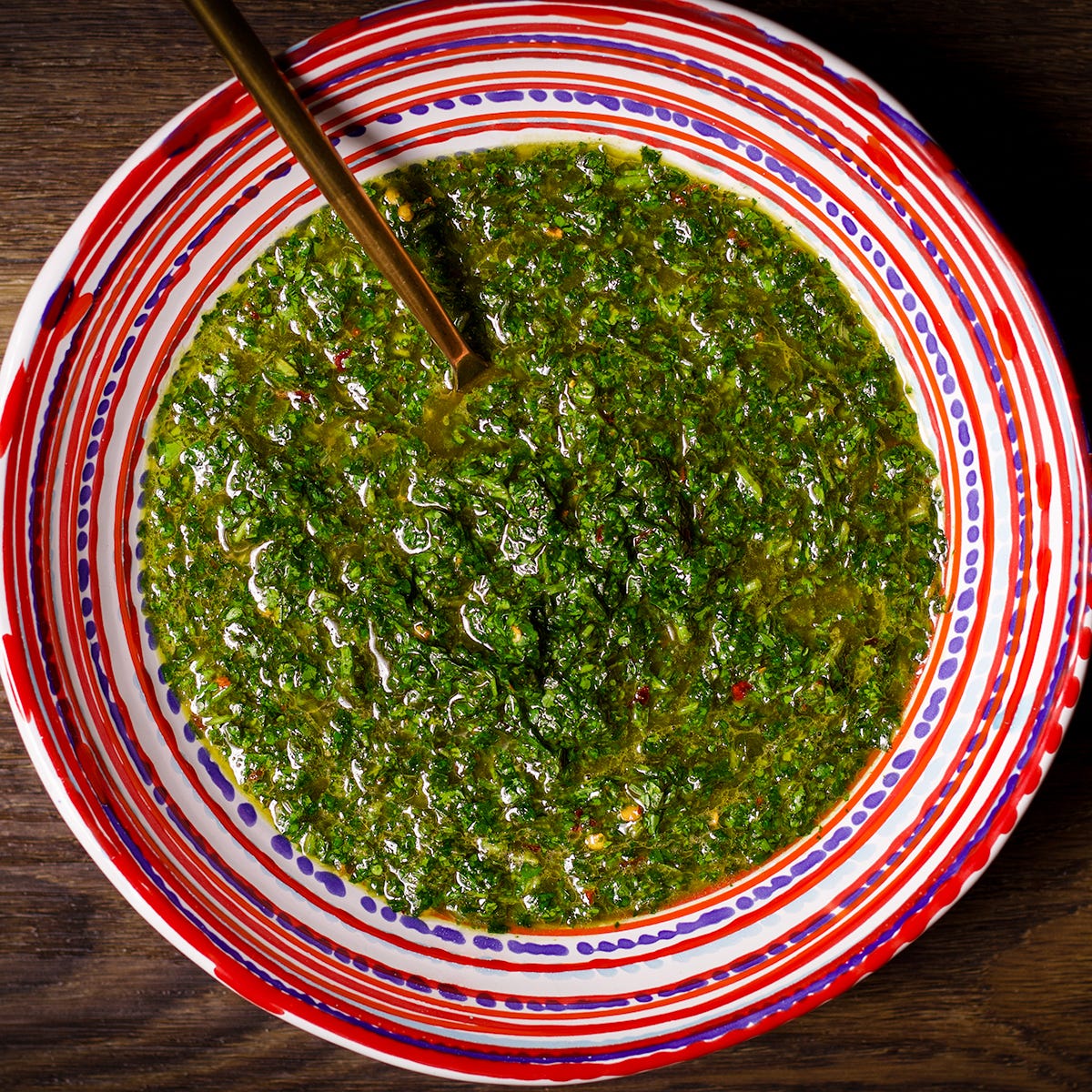
One of the most traditional ways to eat chimichurri is spooned over a perfectly cooked steak. But there are few savory foods that won’t benefit from the intense, bright flavors of this sauce.


Hamburger Bowls with Cheddar, Chimichurri, and Crispy Cabbage Slaw: The combination of juicy beef, melted cheese, crunchy sweet-and-sour slaw, and bright, garlicky chimichurri makes these burger bowls ridiculously flavorful and deeply satisfying. Even better, the whole meal takes just over 30 minutes to prepare, making it an easy high-protein dinner for any night of the week.
Steak and Rice Bowls with Garlic Aioli and Chimichurri: These gorgeous high-protein bowls start with thin slices of perfectly cooked reverse-seared steak piled over bowls of fluffy rice and oven-roasted veggies. Then we kick it up a notch with smoky garlic aioli, a bright, flavor-packed punch of chimichurri sauce, and fresh cherry tomatoes.
Chimichurri Steak Sandwiches: This is one of those sloppy two-handed sandwiches for which you need a stack of napkins and a hearty appetite because there is no chance you'll be leaving even one bite behind. No one has that kind of self control.
Chimichurri Steak Fries: I have discovered the secret to happiness and it comes in the form of saucy steak covered french fries.
Flank Steak with Chimichurri: Grilled flank steak with Chimichurri Sauce is a ridiculously simple meal for the amount of flavor it packs. The steak is seasoned with a dry rub of cumin, chili powder, garlic and oregano, then grilled on an indoor or outdoor grill, or a Blackstone Griddle. Or, if you prefer, the recipe includes instructions for cooking the steak with a Sous Vide Cooker or under a broiler.
Fried Summer Squash with Chimichurri: This super simple technique for crispy fried summer squash produces a light, lacy golden fry that makes the perfect side dish or appetizer.
Vegetarian Chili with Pico de Gallo and Chimichurri: Vegetarian Chili packed with beans, onions, poblano peppers, red bell peppers, zucchini, and tomatoes that are simmered in a spicy red wine broth, then topped with chimichurri sauce, fresh Pico de Gallo, fried tortilla strips, and, if you like, some shredded cheese.
Chicken Nachos with Chimichurri Sauce: Chips, cheese, marinated chicken, and chimichurri. Yes, please.
In other news…
I spoke about collaborations being the most important thing for food writers in our new AI driven world in this podcast for Food Blogger Pro. I also talked about a bunch of other things, income not really being one of them, so I feel the title of this episode is a bit misleading. But I didn’t have a choice. 😉
The Food Writers Business Lab has a new home and a new, more collaborative structure. Naturally.
If you’re someone who’s always wanted to write a cookbook, this class is for you! DIY Cookbook Proposals is taught by Kelsey Erin Shipman who is one of the most insightful and knowledgeable people you’ll meet on this topic.
And speaking of Kelsey, the two of us did a LIVE Q&A earlier this week to answer common questions about writing a cookbook proposal and you can watch the replay here.

This newsletter would not exist if not for the members of The Lost Supper Club, who show their support with a paid subscription, thus ensuring that the vast majority of readers can keep reading this newsletter for free. As a thank you, I try to provide those paid subscribers with some cool stuff, including three free cookbooks and access to The CookStack Collective, 12 months of cooking classes with 12 incredible chefs!
A paid subscription is just $35 a year. Find out more about becoming a member of the Lost Supper Club.
❤️ Did you know that if you hit the heart or recycle symbol at the top or bottom of this post, it makes it easier for other people to find this newsletter?
Your complicated relationship with the word “choice” resonated with me because I have a similarly complicated relationship with it. It made me think of Ina Garten’s Be Ready When the Luck Happens. I have always appreciated her belief that while we do not choose where we begin, luck and preparation often work hand in hand. Opportunity may arrive unexpectedly, but whether we are ready for it is one of the few things we can influence.
This explains alot about you! I always like working with others more than alone but… i like being my own boss.