



People watching has always been one of my favorite activities. So, when we moved into an RV, I was delighted to discover that the people watching opportunities in campgrounds are spectacular.
Campgrounds (and marinas) are busy places, filled with all sorts of people constantly coming and going. Some of these fellow campers capture my imagination and I make up stories about them.
I give them names, spin up a history, and weave together a story. This is the fifth such story I’ve shared here. You can read the others here.
Joey is not a sailor
Joey is an average 17-year-old. At least, that’s how Joey thinks of himself. What average means, of course, depends entirely on who you compare him to.
Compared to the boys on the high school football team, Joey is considerably less than average. He is not tall or athletic or quick on his feet, and he doesn’t really care that he’s none of those things. He has never had a real girlfriend and does not feel especially deprived by this. His level of ambition is what some might call low and what others, especially his parents, might call alarming.
Joey does not see the problem.
He cannot understand why everyone is always in such a hurry to become someone or get somewhere. He is already someone. He is already somewhere. He is Joey. He lives in Michigan. That seems sufficient.
And besides, he is good at some things. He is very good at math. He is a considerably above-average gamer. He can solve a Rubik’s Cube in less than 20 seconds. Last year he picked up a guitar and discovered he could make sense of it almost immediately. Now he can play many of his favorite songs, though only in the privacy of his room because he can’t imagine ever wanting to play for other people.
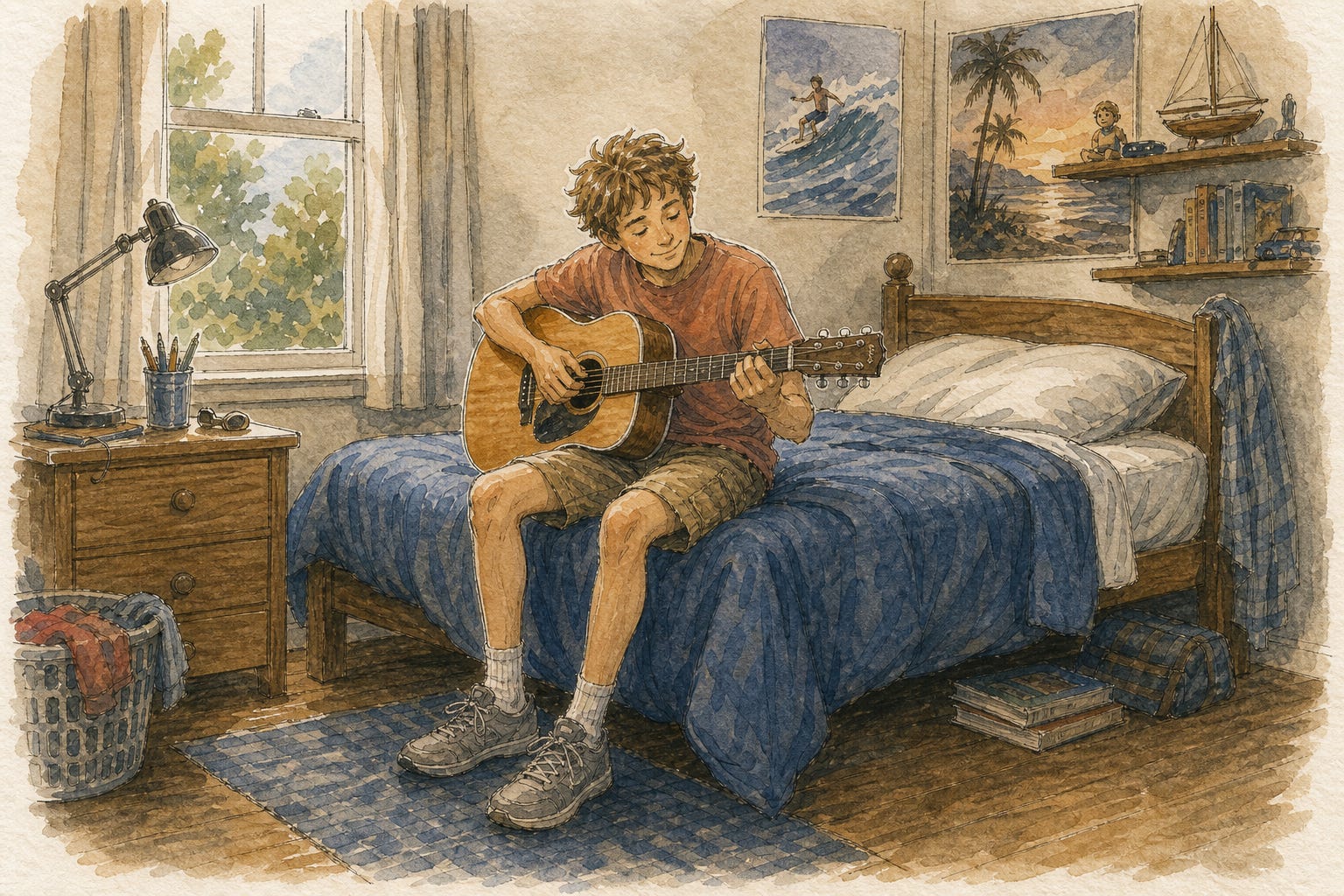
The way Joey sees it, this all evens out. The trouble is that Joey’s parents do not appear to be using the same scorecard.
His parents are, objectively, above average in nearly every measurable way. They are healthy and attractive and athletic and successful and efficient. They have good careers, good posture, good insurance, and the kind of pristine, fashionable home with a bowl of perfectly ripe fruit on the kitchen counter that suggests no one in the house has ever lost their keys.
Joey does not especially mind that he is not like them. But it is increasingly clear that they mind.
They seem to regard Joey’s lack of sparkle as a personal affront. As if their life report card would be a flawless 4.0 if not for the glaring C-minus next to raise an exceptional human.
So now Joey has a summer job.
His father, standing in the kitchen with his sleeves rolled up, presented it as an opportunity! A lesson in real life! An honest day’s work! Character building! And fun!
One of his dad’s college friends owns a marina. A nice one. The kind with a pool and a clubhouse and a sun-kissed staff in matching T-shirts with bright smiles on their faces 24/7. Or at least during working hours.
Except, the sun-kissed staff is kinda sparse this summer because, as Joey’s father explained, kids these days don’t want to work.
But Joey is different, right son?
Joey nods. Sure, Dad.
So here he is on a Saturday in June, on the fuel dock of a resort marina, beginning his second day on the job with absolutely no idea what he is doing.
Joey’s parents own a boat, of course they do, but Joey has not retained any of the information his dad has tried to impart to him while onboard. Mostly, Joey looks out at the water and thinks about whatever song he’s composing and wishes he was back in his room with his guitar. Sometimes he brings a backpack filled with Rubik’s Cubes.
The marina owner’s training method appears to be optimism and osmosis. He deposited Joey at the dock the day before, introduced him to Brad, and said, “Show him the ropes,” which would have been more helpful if Joey had any understanding of ropes. Or cleats. Or boats.
Brad is 20, blond, and suntanned. He looks like the kind of guy who kite surfs or plays beach volleyball in his spare time. Probably both. He’s competent. Patient, even. But he has never trained anyone before so most of Joey’s day is spent watching Brad do things while peering awkwardly over his shoulder, trying to pay attention and hoping he’ll never have to do any of it on his own.
This morning the owner arrived with another new hire. Amy is 18, a year older than Joey, tall and tan, with dirty blond hair pulled into a ponytail and the easy confidence of a person who has spent a lot of time on boats actually paying attention. Her family has one too, but unlike Joey, she has apparently noticed what happens on it. She knows how to move without looking uncertain. She asks questions that make her sound capable. She is learning quickly.
Also, Brad clearly has a crush on her.
For most of the afternoon, Brad and Amy do the work while Joey hovers nearby, summoned occasionally to hold something, fetch something, or perform a task too minor to do much damage.
His shift is nearly over when a sailboat motors toward the fuel dock. Brad is on the phone with a customer, so Amy motions for Joey to follow her out to help tie the boat off.
A woman stands at the bow with a line in her hand. Joey places one hand on the marina’s dock line and freezes. Should he throw it to her? Will she throw hers to him? Is there a boat etiquette to this? Almost certainly yes.
Amy comes to his rescue and tells him to get ready to catch the line the woman throws. The woman throws.
Joey catches it on the first try. Relief and triumph flood his body and he holds up the line like a trophy.
Then the boat keeps moving and Amy tells him to walk with it and tie the line to a cleat. Joey chooses one at random and wraps the line around it in a way that looks, even to him, improvised. Amy helps the man at the wheel tie off the back of the boat then removes the line Joey has secured, moves it to a different cleat, pulling the boat tightly to the dock and securing it with the crisp, slightly irritated efficiency at which some girls seem to excel.
Brad walks out onto the dock and asks the couple what they need.
“Top off the fuel and a pump-out, please.”
Joey has already learned that a pump-out is the worst part of working at a marina. Yes, there are gloves. And yes, a machine does the work. But you are still pumping shit out of a boat and there’s no way to make that an enjoyable experience.
Brad grabs the fuel pump and tells Amy and Joey to handle the pump out.
There follows an awkward, smelly stretch of time during which Amy tries to remember the pump-out procedure while Joey does his best to look useful and avoid breathing through his nose.
The woman steps off the boat and asks if she can pay for the fuel, pump-out, and transient slip all at once. They’ve never stayed at this marina before, she explains. She also needs directions to their slip.
Amy goes with her into the office.
Joey is left on the boat holding the hose, the machine roaring away, completely unsure how he is supposed to know when the thing is finished. Thankfully Brad appears, turns the machine off, takes the hose from Joey, and drops the end into the water to rinse it.
Joey, relieved to no longer be in charge of sewage, turns and notices the man from the sailboat standing on the cabin roof, doing something with the sails.
Suddenly, in one swift and terrible motion, the man disappears. He has slipped off the cabin roof, smacking his head in the process and landing hard in the cockpit.
Everyone goes still.
The woman comes running out of the office. Amy stops just inside the doorway, looking alarmed and terrified. Brad, usually so competent, looks as stunned and helpless as Joey has felt all day.
The woman gets onto the boat and tells the man to get up. Brad offers a first-aid kit. She says they have one and disappears down into the cabin to fetch it. There is blood, but not much. She patches him up quickly, the three of them standing there awkwardly, and then turns to ask them for directions to their transient slip.
Amy points to the marina map. The woman asks whether they’ll need bumpers on the port or starboard side of the boat, receives no useful answer, so studies the map and figures it out.
Then Amy says the thing Joey wishes with all his heart she would not say. “Would you like us to meet you at your slip to help you tie off?”
“Yes,” the woman says, looking sideways at the knot growing on her husband’s forehead. “That would be great.”
Inside the office, the phone rings and Joey can see that another boat is already approaching the fuel dock. Brad says he can handle the approaching boat on his own and tells Joey to untie the sailboat and go with Amy to meet them at the slip.
Joey feels filled with dread but he does as he’s told. He follows Amy down the dock, carrying with him the increasingly sickening awareness that there are many kinds of knowledge in the world and he is missing all the ones currently required.
When the sailboat glides toward the empty slip, Joey says, trying to sound casual and maybe even self-deprecating in a charming kind of way, “I don’t really know what I’m doing here.”
Amy gives him a look that suggests she does not find him charming and says, “Just catch the lines and tie them to the dock.”
Right, then.
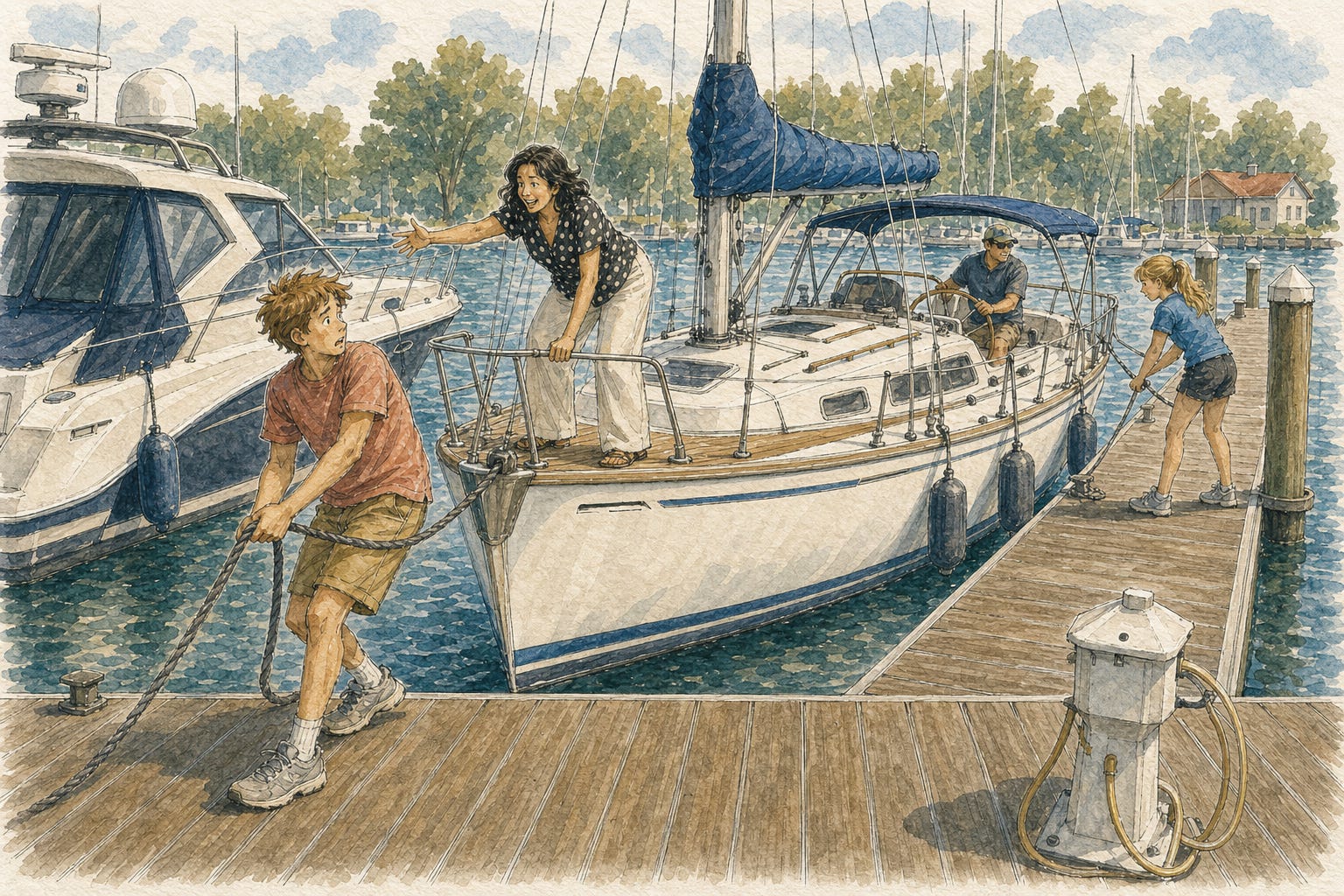
The woman tosses Joey a line from the bow. It is, though Joey does not know it, the spring line and meant to be secured to the center of the slip to keep the boat from hitting the front of the slip. Joey catches the line (another triumph!) and pulls the boat forward. Towards the front of the slip.
The woman yells that they are going to hit the dock.
At the back of the boat, Amy ties another line too far forward, which does nothing to hold the boat back while Joey pulls it forward.
The woman, who is leaning over the bow of the boat, gesturing wildly, yells, “We’re going to hit the dock!”
The boat hits the front of the dock.
Joey just stands there holding the line, frozen. Like an idiot.
Amy rushes forward and takes the line from Joey’s hands. The man, his probable concussion not preventing him from realizing they’d have been better off on their own, loosens the rear line while putting the boat in reverse.
The woman directs Amy to tie the line to the appropriate cleat, which Amy does. The man puts the boat into neutral and comes forward to help. Amy tells Joey to grab the rear line.
Joey grabs it. And then, because no one has yet explained what one does after grabbing a line, he simply stands there holding it while the back of the boat drifts toward the boat in the next slip.
The woman rushes back to help just as Joey drops the line into the water. Of course he does.
The man, now on the dock, hollers for the back line. Somehow the woman gets it to him. Somehow he pulls the boat in. Amy and Joey stand there uselessly, watching the people they were sent to help finish the job themselves.
Then Amy, to her credit, says with a crooked smile, “I’ll bet this is the smoothest docking you’ve ever had.”
The woman laughs. “Yes,” she says. “So smooth.” Then she adds, “Thank you for your help. We’ve got it from here. Really.”
Amy and Joey walk back to the fuel dock. They are both quiet.
Then Amy starts to laugh, so Joey laughs too.
What else can they do?
By the end of the day, Joey knows he smells faintly like gasoline and strongly like humiliation. His shoes are wet. His shirt is sticking to his back. He has been useless in at least six different ways. He has helped crash a sailboat into a dock. He has not shown promise or ambition and is aware that the adults of the world have probably put him in the category of young people who don’t want to work.
When his father asks, “How was work?” Joey shrugs and says, “Fine.”
Which is not true. But it is also not entirely false. Because, an hour earlier, as Joey peddled his bicycle slowly toward home, he thought about how the day’s mishaps just might make a good story and now a song was beginning to form in his mind. He goes upstairs and picks up his guitar.
This piece was written by Rebecca Blackwell with AI generated illustrations.